
Sondur Pain Relief Cushion Claims Evaluated: The Most Comfortable Medical-Grade Travel Seat Cushion on the Market

A 2026 informational overview of the Sondur air cell seat cushion’s pain relief positioning, ROHO technology comparison, tailbone and sciatica comfort claims, portable design specifications, pricing, refund policy conditions, and what to verify before purchasing for office, car, and airplane use
Kentland, IN, April 01, 2026 (GLOBE NEWSWIRE) — This article contains affiliate links. If a purchase is made through these links, a commission may be earned at no additional cost to the buyer. This is an informational overview and does not constitute medical, health, or therapeutic advice. All product details described below are stated as presented by the company and should be verified directly on the official website before any purchasing decision.
The term “medical-grade” in the title reflects the company’s description of the underlying air cell design approach and does not indicate FDA classification, medical device clearance, or equivalence to FDA-registered therapeutic seating devices. References to “claims evaluated” within this release refer to a structured presentation of the product’s stated features, specifications, and design approach as described by Sondur Travel, rather than third-party testing or independent clinical evaluation. The product is presented by the company as a high-comfort seating solution designed for extended use across multiple environments.
Sitting discomfort across extended periods remains a common concern in environments such as offices, vehicles, and air travel. Traditional foam and gel cushions often compress under body heat within the first hour, losing the support they initially provide. The Sondur Pain Relief Cushion is presented as addressing this type of seating limitation through a different mechanical approach — adjustable air cell support rather than static padding materials.
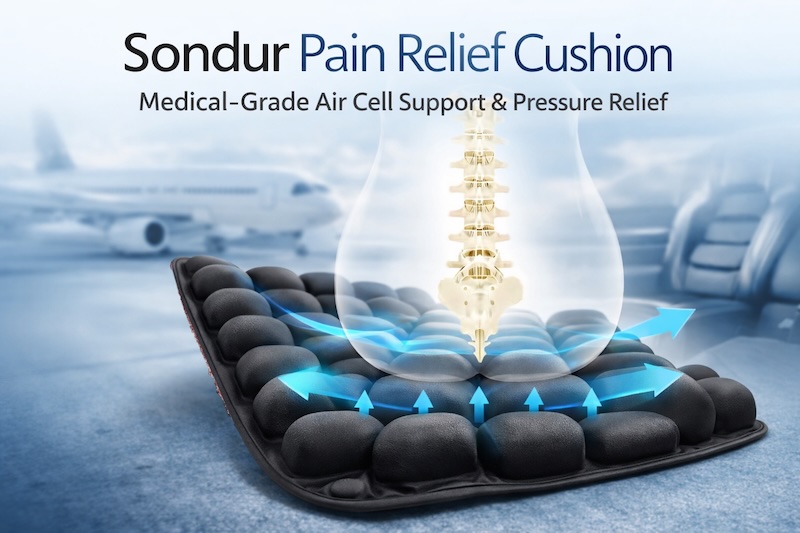
The Sondur Pain Relief Cushion is a portable air cell seat cushion designed to support sitting comfort across offices, vehicles, airplanes, stadiums, and other seat surfaces. The product is described as utilizing air cell pressure redistribution technology commonly associated with medical seating applications — specifically the type of interconnected air cell design found in ROHO medical cushions, which doctors and physical therapists have prescribed for decades in clinical wheelchair seating. ROHO products are FDA-registered Class I medical devices designed for clinical use, whereas Sondur is marketed as a consumer comfort product.
That technology comparison is central to how the product is positioned. There are, however, important distinctions between a clinically prescribed medical wheelchair cushion and a portable consumer seat cushion — and understanding those distinctions is essential for evaluating product suitability.
Current product details, pricing, and terms can be confirmed by viewing the current Sondur Pain Relief Cushion offer on the official Sondur page.
Individual results vary. Seat cushions are not medical devices unless specifically cleared by the FDA. A qualified healthcare professional should be consulted before relying on any consumer product for pain management related to a diagnosed condition.
What Is the Sondur Pain Relief Cushion
Sondur is a portable inflatable seat cushion sold by Sondur Travel, based at 102 E Bailie St, Kentland, IN 47951, US. The product is available through the company’s website at getsondur.com and is presented in partnership with GiddyUp, which the site describes as “a curator of innovative products.” The product page notes that purchasing through the official site supports the inventors directly rather than third-party retailers.
The cushion features a 24-chamber air cell design described as using “hospital-grade air cell technology.” It measures 17.5 by 17.5 inches, weighs under one pound, and inflates manually in two to four breaths. Built-in inflate and deflate buttons allow firmness adjustment while seated, providing a level of customization that static foam or gel cushions do not offer.
The cushion is constructed with premium TPU (thermoplastic polyurethane) and reinforced seams — materials the brand compares to those used in high-end camping gear. The stated specifications indicate it supports up to 396 pounds, and every order includes a replacement air lock pin.
The product is marketed as suitable for office chairs, car seats, airplane seats, stadium bleachers, restaurant chairs, and waiting rooms. The positioning is that a single portable cushion can address sitting discomfort across multiple surfaces rather than requiring separate ergonomic solutions for each seat.
Air Cell Pressure Redistribution: How the Technology Works
The central technology behind the Sondur cushion is air cell pressure redistribution. This is a well-documented principle in medical seating, and understanding how it works clarifies why air cells function differently than foam or gel.
Interconnected air cells distribute body weight across a larger surface area rather than concentrating pressure on specific contact points like the tailbone and sit bones. When weight shifts, air flows between chambers and redistributes accordingly. This principle has been used for decades in clinical settings, particularly in wheelchair seating systems designed to prevent pressure injuries in patients with limited mobility.
ROHO cushions, which Sondur directly references, are among the most recognized pressure redistribution devices in medical seating. ROHO products are FDA-registered Class I medical devices designed for clinical use, and published studies have evaluated their effectiveness in reducing interface pressure and preventing pressure ulcers in clinical populations. Sondur is marketed as a consumer comfort product — it is not positioned as a medical device, is not FDA-cleared or registered for therapeutic claims, and no published comparison study between the Sondur and ROHO products has been identified.
The underlying technology principle of air cell pressure redistribution has been studied in medical seating contexts and is well established. The distinction worth understanding is between that established principle and how any specific consumer product implements it. The Sondur’s 24-chamber design in a lightweight portable format at a consumer price point represents one implementation. Whether it delivers the same functional pressure redistribution as clinical-grade devices engineered for medical applications is a question that independent testing data would need to answer.
Product Features and Specifications as Described by Sondur
The following outlines the Sondur’s key features as stated on the product page, along with additional context for each claim.
17+ Hours of Comfort Without Leaking: The product is described as maintaining consistent support for 17 or more hours without air loss. The company explains that unlike foam, which compresses under body heat, and gel, which warms and loses structure, air cells maintain support because the air inside does not soften or degrade over time. The 17-hour figure is the brand’s stated performance benchmark. Air retention depends on valve integrity, chamber construction, and environmental factors.
62,000+ Customers: The product page displays this figure prominently. This is the company’s stated customer count and has not been independently verified through third-party sales data. It provides context for the product’s stated market presence.
Hospital-Grade Air Cell Technology: The company uses this term to describe the type of air cell design in the cushion — specifically the interconnected chamber concept used in medical seating. The term “hospital-grade” is the brand’s marketing descriptor and does not indicate FDA classification, medical device registration, or clinical-grade manufacturing certification.
Supports Up to 396 lbs: This is a stated engineering specification — a testable, verifiable claim that can be evaluated against individual needs.
Fits Any Standard Seat (17.5″ x 17.5″): The product is designed to fit standard office chairs, car seats, airplane seats, and stadium bleachers. The non-slip bottom is described as keeping the cushion in place across different surfaces.
Waterproof and Easy to Clean: The TPU material is described as waterproof with a wipe-clean surface. This is a material property consistent with thermoplastic polyurethane construction.
Airline-Friendly: The company states the cushion deflates and rolls into a compact package that fits inside a carry-on bag. The product page notes that no airline has flagged the cushion as prohibited. For altitude adjustments, the recommendation is to inflate to approximately 50 to 60 percent capacity on the ground and use the deflate button to adjust as cabin pressure changes during flight.
Who the Sondur Pain Relief Cushion Is Designed For
People who sit for extended periods across multiple settings: For individuals whose discomfort is not tied to one specific chair but follows them from desk to car to airplane, a portable solution that travels across environments may address the problem more efficiently than seat-specific upgrades.
People who have tried foam and gel cushions without lasting relief: For those whose experience matches the common pattern — initial comfort followed by compression and heat buildup within the first hour — air cell technology operates on a fundamentally different principle. Air does not compress the way foam does and does not warm up the way gel does. Individual experience will vary, but the mechanism is distinct.
People dealing with tailbone sensitivity, sciatica, or post-surgical sitting discomfort: The product’s design lifts the tailbone area off the seat surface through air suspension rather than padding. For conditions involving pressure sensitivity, this approach is intended to reduce direct contact pressure. Anyone managing a diagnosed medical condition should consult a healthcare provider before relying on a consumer product for symptom management.
Frequent travelers who need a compact, portable option: The cushion deflates, rolls up, and fits into a carry-on bag. For individuals who have avoided bringing cushions on trips due to bulk, this design is intended to address that limitation.
Who May Want to Consider Other Options
People who need a clinically validated medical device: If a healthcare provider has recommended a pressure redistribution cushion for medical reasons — particularly for pressure injury prevention — a consumer comfort product may not be the appropriate choice regardless of the technology principle it uses. FDA-registered options like ROHO are designed for clinical applications.
People who prefer zero-setup cushions: The Sondur requires manual inflation (two to four breaths) and firmness adjustment each time it is used. For individuals who prefer a ready-to-use option that requires no interaction, a static foam or gel alternative — despite the tradeoffs in long-term support — may be more practical.
People who rely on independent clinical testing before purchasing: No published third-party study evaluating the Sondur cushion’s specific performance has been identified. For individuals who require clinical evidence as part of the purchasing process, that is worth factoring in.
Questions to Consider Before Purchasing
Is the sitting discomfort tied to one specific seat, or does it persist across multiple seating surfaces? If it persists across environments, a portable solution may make more practical sense than replacing individual chairs.
Has the sitting pain been discussed with a healthcare provider? If the discomfort is related to a diagnosed condition like sciatica, herniated discs, or a tailbone injury, medical guidance should come before any consumer product purchase.
Is the setup process of inflating and adjusting an air cushion each time acceptable? This product requires more hands-on involvement than a static foam option.
Have the actual refund policy terms been reviewed — not just the marketing headline? The details matter, and the section below explains why.
Sondur Pricing and Purchase Structure
The Sondur Pain Relief Cushion is sold directly through getsondur.com. The site presents the product in partnership with GiddyUp as a special offer. Specific pricing, bundle options, and shipping terms are displayed on the product page and may vary based on current promotions.
The company indicates that qualifying orders ship with free US shipping, with delivery typically within 3 to 5 business days. International shipping is available to over 30 countries, with potential customs, duties, or VAT fees charged upon delivery depending on the destination. All international orders are processed in US dollars. Orders are described as typically shipping within 24 to 48 hours of placement.
Pricing and promotional offers are subject to change. Current details are available by viewing the current Sondur Pain Relief Cushion offer on the official Sondur page.
Sondur Refund Policy: What the Marketing Says vs. What the Terms Require
The product page prominently displays a “60-Day Money-Back Guarantee” alongside messaging that reads: “Try Sondur risk-free and if you don’t love it, we’ll fix it.”
The actual refund policy terms contain important conditions worth reviewing carefully before purchasing — because the practical application of this guarantee may differ from what the headline suggests.
The company’s return policy states that to qualify for the money-back guarantee, the product must be returned in “new, unused condition” with the seal still intact. The policy explicitly states that opened and used products are excluded from the money-back guarantee. The company cites “strict infection control protocols and hygiene reasons” for this restriction, noting: “Once this seal is broken and the package is opened, we can not accept returns unless the product is deemed faulty from manufacturing.”
Additional terms outlined in the policy include: return shipping costs are the customer’s responsibility; shipping and handling charges, packaging fees, shipping protection, warranty costs, and taxes are non-refundable; and returns without a Return Merchandise Authorization (RMA) number may be refused or subject to a restocking fee of up to $79.00 USD.
What this means in practice: the “60-day money-back guarantee” as written requires returning the cushion without having opened or used it. For a product marketed with “try risk-free” language, the guarantee does not appear to cover products that have been tested or used based on the stated terms.
Every order does include a 1-year warranty covering manufacturing defects. Defective products require contacting customer support with a description of the issue, order number, and photos or video of the fault. The warranty does not cover general wear and tear, water damage, modifications, or user-caused damage.
The complete refund policy and warranty terms should be reviewed on the official website before purchasing. All order confirmation details should be retained.
Frequently Asked Questions
Is the Sondur a medical device?
The product is not positioned as a medical device. It is marketed as a consumer comfort product. The “hospital-grade” language describes the type of air cell technology used, not a regulatory classification. The product does not appear to carry FDA clearance or medical device registration.
How does the Sondur relate to ROHO cushions?
The product page describes the Sondur as using “the same interconnected air cell technology as ROHO cushions” in a portable consumer format. ROHO cushions are FDA-registered Class I medical devices designed for clinical use, whereas Sondur is marketed as a consumer comfort product. No published independent study comparing the two products has been identified. The shared technology principle does not establish performance equivalence between a consumer product and a clinical device.
Is the Sondur designed for people with sciatica or tailbone injuries?
The company’s FAQ states that customers with sciatica, herniated discs, tailbone injuries, hip replacements, and chronic lower back pain have reported relief. These are the company’s stated customer reports. Anyone managing a diagnosed condition should consult a healthcare provider for guidance specific to their situation.
Can the product be returned after use?
The stated refund policy requires the product to be returned in new, unused condition with the seal intact. Products that have been opened and used are excluded from the money-back guarantee unless deemed defective from manufacturing. The complete return terms should be reviewed before purchasing.
Is the 17-hour comfort claim verified?
The product is described as maintaining support for 17 or more hours without air loss. This is the brand’s stated performance benchmark. Air retention depends on valve integrity, chamber construction, and environmental factors.
Does altitude affect the cushion on flights?
The company’s FAQ notes that cabin pressure can slightly expand the air during climb. The recommendation is to inflate to approximately 50 to 60 percent capacity on the ground and use the deflate button to adjust during flight.
Where is Sondur Travel located?
Sondur Travel is based at 102 E Bailie St, Kentland, IN 47951, US. The listed phone number is +61 423 733 680, and the support email is support@sondurtravel.com.
What is GiddyUp’s role?
The official website states that Sondur Travel has partnered with GiddyUp, described as “a curator of innovative products, to present a special offer.” GiddyUp operates as a marketing and distribution partner. Product support, warranties, and returns are handled by Sondur Travel directly.
Contact Information
For questions before or during ordering, the company’s stated contact information includes:
Company: Sondur Travel
Address: 102 E Bailie St, Kentland, IN 47951, US
Email: support@sondurtravel.com
Phone: +61 423 733 680
Complete product details and current pricing are available by viewing the current Sondur Pain Relief Cushion offer on the official Sondur page.
Summary of Key Considerations
The Sondur Pain Relief Cushion is a consumer comfort product built around air cell pressure redistribution — a technology principle with established applications in medical seating. The product references ROHO medical cushions as a technology comparison and uses terms like “hospital-grade” to describe the design approach. These describe the brand’s positioning for the underlying technology concept, not regulatory classifications or independently verified performance equivalences.
The product offers a fundamentally different mechanism than foam or gel alternatives through adjustable air suspension, and the portable 17.5-inch design addresses a gap in the market for individuals who need sitting comfort across multiple surfaces. The 24-chamber layout, TPU construction, and sub-one-pound weight represent a design approach that could offer meaningful utility for the right individual.
Close attention should be paid to the refund policy terms, which require the product to be returned unused and sealed for the money-back guarantee to apply — an important detail given the “try risk-free” marketing language. The “hospital-grade” and ROHO comparison claims describe the technology approach rather than clinical validation. Anyone considering a purchase specifically for a medical condition should discuss options with a healthcare provider first.
Complete product details, current pricing, and stated terms are available by viewing the current Sondur Pain Relief Cushion offer on the official Sondur page.
Disclaimers
Content and Consumer Information Disclaimer: This is an informational overview and does not constitute medical, health, therapeutic, or legal advice. All product details, specifications, technology claims, and policy terms described here are stated as presented by the company on its publicly available website and product documentation. Readers are encouraged to verify all claims directly with the manufacturer and to consult a qualified healthcare professional before relying on any consumer product for pain management.
Medical Device and Technology Disclaimer: The Sondur Pain Relief Cushion is marketed as a consumer comfort product, not a medical device. References to “hospital-grade” technology and comparisons to ROHO medical cushions reflect the company’s product positioning and do not indicate FDA clearance, medical device registration, or equivalence to clinically validated medical seating systems. The FDA does not evaluate consumer comfort products for therapeutic efficacy. Individuals with medical conditions requiring pressure management seating should consult a healthcare provider about FDA-registered options.
Results and Experience Variability: Individual experiences with seat cushions vary based on factors including body weight, sitting duration, underlying health conditions, seat surface type, and individual anatomy. The company’s stated customer reports and performance claims represent the brand’s information and do not guarantee specific outcomes for any individual user.
FTC Affiliate Disclosure: This article contains affiliate links. If a product is purchased through these links, a commission may be earned at no additional cost to the buyer. This compensation does not influence the accuracy, neutrality, or integrity of the information presented. All descriptions are based on publicly available information from the company’s official website.
Pricing and Policy Disclaimer: All pricing, shipping terms, promotional offers, refund policies, and warranty terms referenced here are based on information available on the official product website at the time of writing (April 2026) and are subject to change without notice. Current terms should always be verified on the official website before making a purchase decision.
Publisher Responsibility Disclaimer: Every effort has been made to ensure accuracy at the time of writing based on publicly available information. No responsibility is accepted for errors, omissions, or outcomes resulting from the use of the information provided. Readers are encouraged to verify all details directly with Sondur Travel and a healthcare provider before making decisions.
CONTACT: Email: support@sondurtravel.com
Phone: +61 423 733 680
 Disclaimer: The above press release comes to you under an arrangement with GlobeNewswire. NYnewscast.com takes no editorial responsibility for the same.
