Gemma 4 Good Challenge winners announced for innovative AI solutions

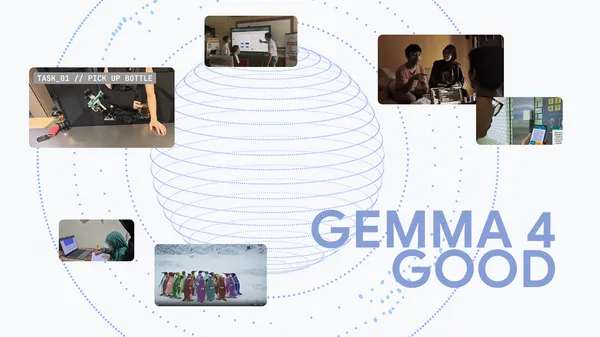
The winners of the Gemma 4 Good Challenge have been announced, showcasing AI solutions designed to tackle global challenges. This competition, hosted by Kaggle, invited developers to create impactful AI technologies using the latest Gemma 4 models.
Developers faced the difficult task of deploying these models in environments with limited resources, utilizing technologies like LiteRT, Cactus, Ollama, llama.cpp, and Unsloth to develop efficient solutions for everyday devices. Here are some of the winning entries:
Highlighting the Winners
- GEM-4: An innovative robotic assistant designed to help elderly and disabled individuals with daily tasks. It uses a Gemma 4 31B model for video labeling and a lightweight Gemma 4 E2B controller for physical assistance, praised for its comprehensive VLA architecture.
- Trido: A voice-controlled digital whiteboard aimed at assisting educators, especially those with disabilities. It facilitates interactive classroom teaching through a Gemma 4 E2B model, recognized for its user empathy and offline capabilities.
- PenguinAgent: A research tool for wildlife ecologists working in remote locations, which uses a Gemma 4 26B model to analyze wildlife behavior and access scientific data privately.
- DEMENTOR: A supportive tool for dementia patients, integrating sensors and feedback mechanisms to aid caregivers, emphasizing user safety and privacy.
- Acuífero·Vigía: A flood warning system operational in South America, praised for its technical sophistication and use of Gemma 4 E2B to anticipate floods without data overflow issues.
- TrueVoice: Designed to combat voice-cloning fraud, this project uses Gemma 4 E4B to detect and prevent scams by analyzing vocal patterns, providing a crucial safety layer.
- Gem-Care: Helps individuals with speech disabilities communicate effectively using a refined Gemma 4 E2B model, celebrated for reducing error rates in speech recognition.
- CodeBuddy: Offers programming education to Indonesian students without internet access, facilitating coding lessons through offline AI-powered transcription and debugging.
- Project Rosie: Supports canine cancer treatment by helping veterinarians design personalized vaccines, noted for its precise and non-erroneous framework.
- Gilbeot: An on-device navigation assistant for seniors, converting machine coordinates to human-readable directions, optimizing performance on Android devices.
- PreVillage: Facilitates access to government services in Nepal using a voice-based navigator, lauded for its user-centered design and efficient AI utilization.
- PathOS: An offline cancer screening assistant for rural clinics, leveraging reinforcement learning for reliable on-device diagnostics.
- MindBridge: A mental health evaluation tool for Hindi-speaking regions, providing a robust mobile application with accurate local translations.
- KawanIsyarat: Eases communication for Indonesian Sign Language users through a two-way assistant on smartphones, recognized for its real-time performance and memory management.
With over 1,600 entries submitted in just six weeks, the Gemma 4 Good Challenge has offered numerous AI solutions with the potential to benefit communities worldwide. As Gemma continues to reach new milestones, including one billion downloads, a heartfelt thank you and congratulations go out to all the participants who contributed their innovative ideas to this initiative. The future looks promising as these projects evolve to bring positive changes globally.